In Germany, working time recording refers to the systematic documentation of employees' working hours. It includes the start and end of working hours as well as breaks and overtime. Whether timesheets, Excel spreadsheets or apps - it is currently (still) possible to record working hours both manually and digitally. However, the ruling of the European Court of Justice(ECJ) provides for a comprehensible and tamper-proof system.This raises the question of whether the traditional timesheet still meets this requirement at all. In addition, the concrete cornerstones of the upcoming amendment to the law on working time recording have yet to be defined. The fundamental aim of recording working hours is to ensure compliance with legal requirements, in particular the Working Hours Act, and to create transparency in the organization of work .
On September 13, 2022,the Federal Labour Court (BAG) clarified in a landmark ruling that employers have a general obligation to systematically record working hours. In doing so, the BAG referred to a ruling by the European Court of Justice (ECJ) in May 2019. In this so-called time clock ruling, the member states were already obliged to introduce a system for recording working hours.
The full reasons for the BAG's decision have also been available since December 2022. According to this, employers must record their employees' working hours. The Federal Government will now have to take action following the Federal Labor Court's reasoning and amend the Working Hours Act in line with all outstanding details. In particular, companies that have not yet systematically recorded their employees' working hours should therefore push ahead with the rapid implementation of time recording - also in view of the new realities of the working world.
Overall, it is important to create transparency and ensure that overtime and working hours are documented correctly. Although the ECJ ruling points the way forward, legal implementation in Germany has not yet been fully completed. However, the BAG has confirmed the necessity of recording working hours. Employers are therefore obliged to ensure a "suitable organization and provide the necessary means" for this .
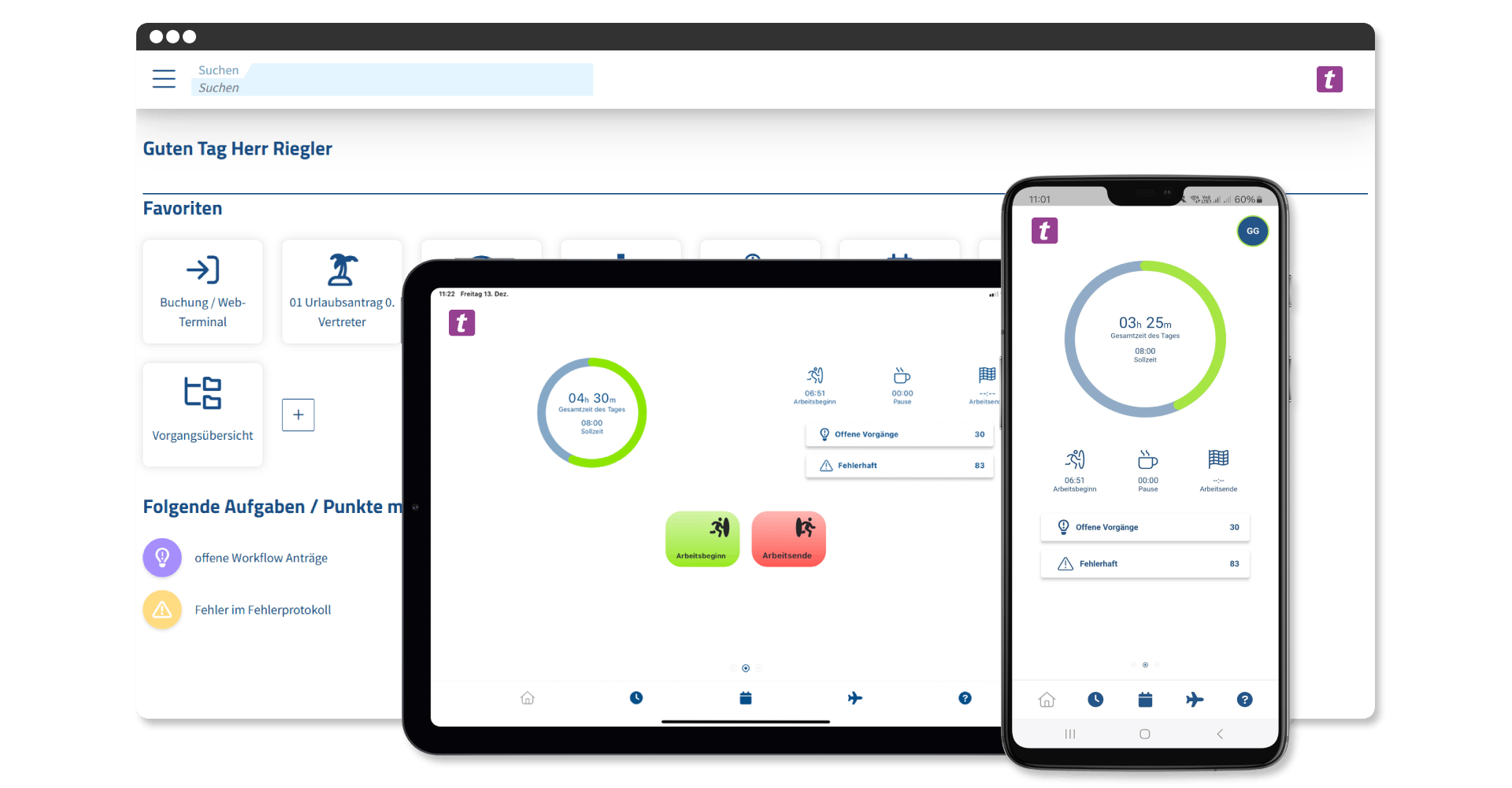
The use of digital systems gives employers an immediate overview of their employees' working hours, ensuring a clear view of hours worked, overtime and absences. This real-time data enables traceable documentation, which helps to avoid any misunderstandings or conflicts. Another advantage is the automated documentation of all recorded information. This ensures that all legal requirements are met, reduces the risk of legal problems and creates a higher level of trust between employers and employees. In addition, digital time recording significantly reduces the administrative burden, as manual entries are no longer necessary, but corrections can be made more easily and transparently. The automated processes also speed up payroll procedures, as the data can be integrated directly into the payroll systems.
The flexibility of electronic systems also allows employees to record their working hours regardless of location, which is particularly important when working from home, but also for teams in the field or on the assembly line. Finally, the analysis of the collected data enables companies to identify patterns and trends that contribute to the optimization of work processes and resource planning. All in all, the digital recording of working times not only increases the efficiency of company processes, but also promotes a transparent and fair working environment.
The Working Hours Act was introduced in Germany to protect the rights of employees and create clear guidelines for employers. According to the legal provisions, regular working hours may average eight hours a day, with a maximum working time of ten hours. If this maximum limit is exceeded, compensation must be paid within six months. There are also clear rules on break times and days off at weekends and on public holidays, including rest periods between working days.
Furthermore, employers are required by law to document overtime in excess of regular working hours. These records must be kept for at least two years. This is intended to create transparency and ensure that working time regulations are taken into account. Mini-jobbers, i.e. those in marginal employment, are also required to keep accurate records of their working hours. This is to ensure that they are paid the statutory minimum wage. This regulation applies in particular to sectors mentioned in the Act to Combat Illegal Employment, such as construction, catering, transportation and building cleaning.
Providers of time recording solutions support data protection through a combination of technical and organizational measures that meet the requirements of the General Data Protection Regulation (GDPR). This includes the encryption of all data, both during transmission and storage. This ensures that sensitive information, such as employees' personal data and working hours, cannot be viewed or changed without authorization. The use of modern encryption algorithms protects data from external attacks.
Another key aspect of data protection is user role and rights management. This allows companies to determine which employees are allowed to access which data. Different levels of access can be set individually depending on the type of data. The right software also ensures that all other employees can only view their own data, thus preventing misuse or unauthorized access within the company. In addition, the systems are usually configured in such a way that the data is stored on servers with high security standards. For example, if you use the Atoria time recording solution tisoware in the cloud, all data is processed in a secure, ISO-certified data center in Germany. These data centers have measures such as access controls, fire and water protection as well as monitoring systems to guarantee the physical security of the data.
Most time recording systems offer the option of creating regular backups to prevent data loss. Detailed logs of access and changes to the data ensure traceability in the event of a data breach.